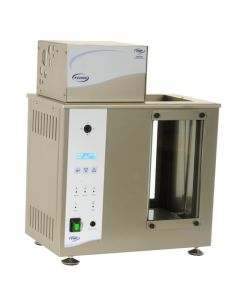
Standard Test Method for Density and Relative Density (Specific Gravity) of Liquids by Bingham Pycnometer
This test method covers the measurement of the density of pure hydrocarbons or petroleum distillates boiling between 90 °C and 110 °C that can be handled in a normal fashion as a liquid at the specified test temperatures of 20 °C and 25 °C.
1.2 This test method provides a calculation procedure for the conversion of density to relative density (specific gravity).
The measuring principle is based on a calibrated glass bottle with capillary
Density determined from:
Mass of liquid
Precisely known volume
The methods require tight temperature control
Feature
ASTM D1480
ASTM D1217
Instrument
Bingham pycnometer
Bingham pycnometer
Sample Type
Medium High viscosity
Low–medium viscosity
Accuracy
Higher
High-accuracy lab reference
Speed
Slower
Time consuming
Automation
Manual
Manual
Temperature Sensitivity
±0,01°C
±0,01°C
Range
100°C
110°C
It is mainly used for:
Lubricating oils
Hydraulic fluids
Aviation turbine fuels
Diesel and light fuel oils
Solvents and refined petroleum fractions
Designed for low-viscosity liquids
Typically used for products with:
Vapor pressure not too high
Kinematic viscosity generally below ~15 mm²/s at 40 °C
Originally this test method was developed for the determination of density of ASTM Knock Test Reference Fuels with an accuracy of 0.00003 g/mL. Although it is no longer used extensively for that purpose, the method is still useful whenever accurate densities of pure hydrocarbons or petroleum fractions with boiling points between 90 and 100°C are required.
Precision
This test method has a repeatability of 0.00002 and a reproducibilityof 0.00003.
Specific bias has not been determined.
Test
The liquid sample is introduced into a pycnometer equilibrated to the desired temperature, and weighed. Weight of water required to fill the pycnometer at the same teniperature is also measured. Both weights are corrected for the buoyancy of air before calculating density and relative density.