


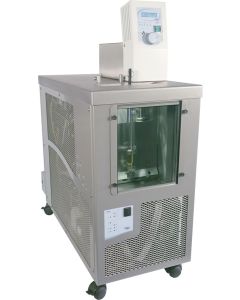
General
IP 71 is the Energy Institute (formerly the Institute of Petroleum) standard for determining the kinematic viscosity of transparent and opaque petroleum products and related liquids. Kinematic viscosity is a measure of a fluid's resistance to flow under the influence of gravity and is expressed in square millimetres per second (mm²/s or cSt).
The method is based on measuring the time required for a fixed volume of sample to flow through a calibrated glass capillary viscometer under precisely controlled temperature conditions. The measured flow time is multiplied by the viscometer calibration constant to obtain the kinematic viscosity.
IP 71 is widely used for:
- Lubricating oils
- Base oils
- Hydraulic fluids
- Gear oils
- Transformer oils
- Fuel oils
- Biodiesel and biofuel blends
- Other petroleum and synthetic liquids
The most common test temperatures are 40 °C and 100 °C, although other temperatures may be used depending on product specifications.
Precision
The precision of IP 71 depends on the viscosity range and the quality of laboratory practice. The method contains statistically determined precision data based on interlaboratory studies.
The precision is expressed as:
- Repeatability (r): maximum acceptable difference between two test results obtained by the same operator using the same equipment under identical conditions.
- Reproducibility (R): maximum acceptable difference between two results obtained by different laboratories.
The repeatability and reproducibility values increase with increasing viscosity. Typical modern laboratories equipped with automatic viscometers often achieve significantly better repeatability than the formal limits specified in the standard.
Test
Physical property test
Measurement principle
- Capillary glass viscometry
- Gravity-driven flow
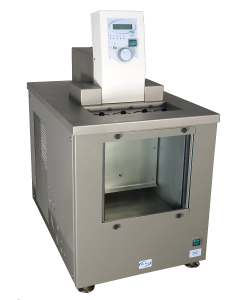
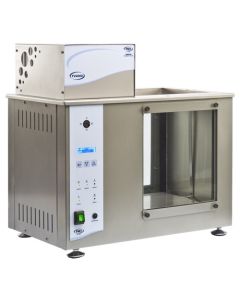
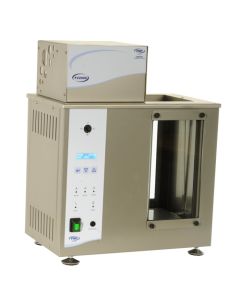
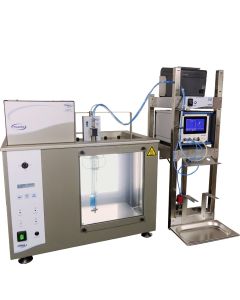
- Constant-temperature bath
- Manual or automatic measurement
- Determination of kinematic viscosity
Result
- Kinematic viscosity (mm²/s or cSt)
Difference between D445 and IP 71
For most laboratories there is no practical difference in performing the test and identical to used:
- capillary viscometers
- constant-temperature baths
- temperature control requirements
- calculation of viscosity
- reporting units (mm²/s)
As a result, laboratories that comply with one method can generally comply with the other with minimal or no changes in equipment or procedures.