


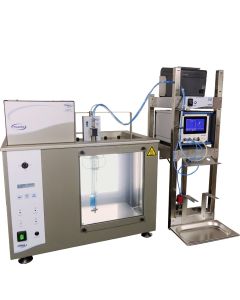
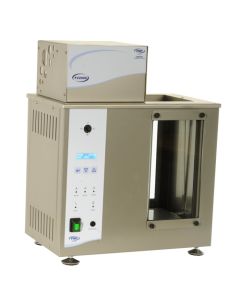

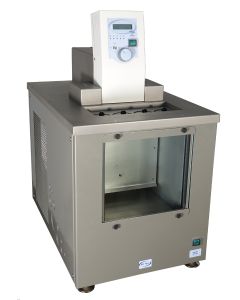
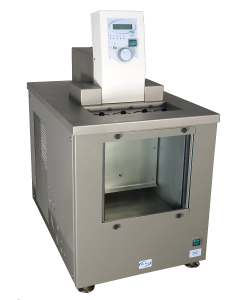
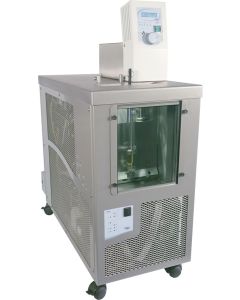
General
This test Miethod covers the determination of the kinematic viscosily of liquid petroleum products.
Both transparent and opaque, by measuring the time for a volume of liquid to flow under gravity through a calibrated glass capillary viscometer. (Dynamic viscosity can be obtained by multiplying the measured kinematic viscosity by the density of the liquid).
This test method is primarily intended for application to liquids for which the shear stress and shear rates are proportional. The method also includes the determination of the kinematic viscosity of fuel oils which often exhibit nonNewtonian properties.
Kinematic viscosity is a measure of the resistive flow on a fluid under gravity, the pressure head being proportional to the density, ρ of the fluid: for gravity flow under a given hydrostatic head, the pressure head of a liquid is proportional to its density, ρ. For any particular viscometer, the time of flow of a fixed volume of fluid is directly proportional to its kinematic viscosity, ν=η/ρ, where η is the dynamic vlscosity coefficient. The kinematic viscosity coefficient has the dimension L^2/T, where L is a length, and T is a time. The cgs unit of kinematic viscosity is one centimetre squared per second and is called one stokes (symbol St). The SI unit kinematic viscosity is one metre squared per second and is equivalent to 104 ST. Frequently, the centistokes (symbol cSt) isused(l cSt=10^-2 St=1mm^2/s)
|
Sample |
Determinability |
Repeatability (r) |
Reproducibility (R) |
| Base oils @ 40°C |
0,37% |
1,01% |
1,36% |
| Base oils @ 100°C |
0,36% |
0,85% |
1,90% |
| Formulated oils @ 40°C |
0,37% |
0,74% |
1,22% |
| Formulated oils @ 100°C |
0,37% |
0,84% |
1,38% |
| Formulated oils @ 150°C |
1,5% |
0,56% |
1,8% |
| Gas Oil @ 40°C |
0.015 |
|
0,0082 (x + 1) |
| Jet Fuels @-20°C |
|
0,7% |
1,9% |
| Petroleum wax at 100°C |
0,80% |
0,0141 x |
0,037x |
| Residual fuel oils @ 8O and 100°C |
0,011 (y+8) |
0,013 (x + 8) |
0,04 (x + 8) |
| Residual fuel oils @50°C |
1,7% |
1,5% |
0,04 (x + 8) |
Where y is the average of determinations being compared; x is the average of results being compared.