


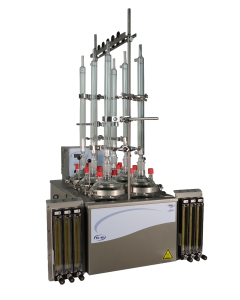
General:
This test method provides a simple beaker-type procedure to evaluate the corrosive effects of non-aqueous engine coolants on various metal specimens.
It may be referenced in:
- OEM coolant approvals
- Hybrid & high-output engine specifications
- Advanced OAT and HOAT coolant validations
- Especially relevant for:
- Aluminum cylinder heads
- Turbocharged engines
It simulates conditions in engine cooling systems to assess the coolant’s ability to protect metals against corrosion.
Limitations of the ASTM-D7935 are:
- Requires specialized apparatus
- Not a full engine simulation
Precision:
The standard includes repeatability and reproducibility statements based on interlaboratory testing. Precision is expressed for mass loss or corrosion ratings of individual metals. Detailed values are provided in the full ASTM document.
Test:
Metal test specimens (typically a bundle of different metals) are immersed in a measured volume of the coolant in a glass beaker. The assembly is heated under controlled temperature with aeration or reflux for a specified duration. After the test, specimens are cleaned and evaluated for mass loss, appearance changes, and corrosion.
Compared to ASTM D1384:
|
ASTM D1384 |
ASTM D7935 |
|
Static glassware |
Heated aluminum surface |
|
14 days |
14 days |
|
Multiple metals |
Aluminum-focused |
|
Weight loss only |
Weight loss only |