


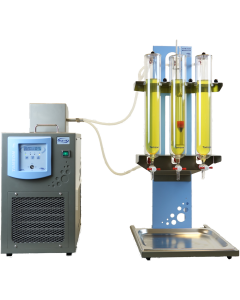
General:
The method helps ensure that engine oils from different manufacturers can be mixed without causing phase separation or loss of performance.
Precision:
No information is presented about either the precision or bias of Test Method D6922 for measuring homogeneity and miscibility since the test results are nonquantitative.
Test:
Visual color determinations and observations are made on an undiluted test oil specimen. The pour point is then determined for the undiluted test oil specimen and the six blends. The undiluted test oil specimen and six blends are then allowed to warm to room temperature. Color determinations and observations are again made on the test oil specimen. The oil is heated to 232 °C, then allowed to cool to room temperature, and then stored at pour point temperatures for 18 h to 24 h. The sample is allowed to thaw and color determinations and observations are made at room temperature.