ASTM D70

Standard Test Method for Density of Semi-Solid Bituminous Materials (Pycnometer Method)

Standard test method for measuring the density (or relative density / specific gravity) of semi-solid bituminous materials like asphalt cement.


It is used for Asphalt binders, Bitumen, Tar and pitch materials.


Engineers use this test mainly in road construction, paving, and materials quality control.


ASTM D70 determines density using a pycnometer (a small, precisely calibrated glass flask):

  • A known mass of asphalt is placed in the pycnometer
  • The pycnometer is filled with water
  • Measurements are taken at a controlled temperature (usually 25 °C)
  • Density or specific gravity is calculated from mass and volume relationships


This gives a very accurate density value for materials that are too thick for simple liquid density tests.

View as Grid List

1 Item

Set Descending Direction
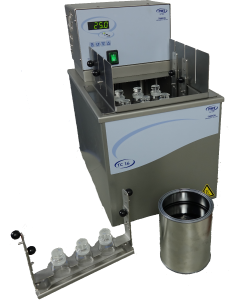
  1. TC16 used for ASTM-D70
    TC16 used for ASTM-D70
per page

General

Fully refined petroleum oils normally contain no naptha insoluble material. Semirefined or black oils frequently contain some naptha insoluble material, sometimes referred to as asphaltenes. This test nieasures the amount of naptha insoluble material in the steam cylinder stocks, black oils, and lubricating oils. This quantity is reported as the precipitation nuniber.

Test

Ten mL of lubricating oil is mixed with 90 mL of ASTM precipitation naptha, and centrifuged for 10 mm at a rcf of between 600 and 700. Volume on the bottom of the centrihige cone is read until repeat centrifugation gives a reading within 0.1 mL. This reading is reported as the precipitation number.

Precision

In the precipitation number range of 0,00 to 1.20, the test repeatability is 10 % of the mean, and the test reproducibility is 30 % of the mean. This procedure is empirical, and no statement of bias can be made.