


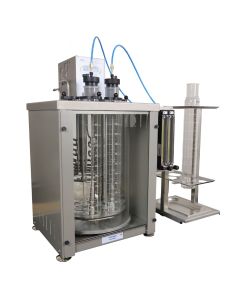
General:
This test method evaluates the foaming tendency of non-aqueous engine coolants under controlled laboratory conditions. It helps assess the potential for foam formation in engine cooling systems, which can affect cooling efficiency and performance.
Foam formation in cooling systems can lead to:
- Air entrapment
- Reduced heat transfer
- Pump cavitation
- Circulation inefficiency
Precision:
The method provides repeatability and reproducibility statements based on interlaboratory studies. Precision values are given for both foam volume (tendency) and foam stability in the full standard document.
Test:
A specified volume of the coolant sample is placed in a glass cylinder and aerated using a diffuser at a controlled temperature and airflow rate for a set time. The volume of foam generated immediately after aeration (foaming tendency) and the volume remaining after a drainage period (foam stability) are measured and recorded.
|
Parameter |
D892 |
D1881 |
D7840 |
|
Fluid type |
Oil |
Coolant |
Coolant |
|
Base fluid |
Hydrocarbon oil |
Water/glycol |
Water/glycol |
|
Temperature regulation |
± 0.5 °C |
±1 °C |
±1 °C |
|
Test temperature |
24 °C, 43.5 °C and 93.5 °C |
88 °C |
88 °C |
|
Air supply |
94 mL ⁄min 6 5 mL ⁄min |
1000 mL ⁄min ±25 mL ⁄min. |
1000 mL ⁄min |
|
Sector |
Lubrication |
Automotive |
Heavy duty cooling |