


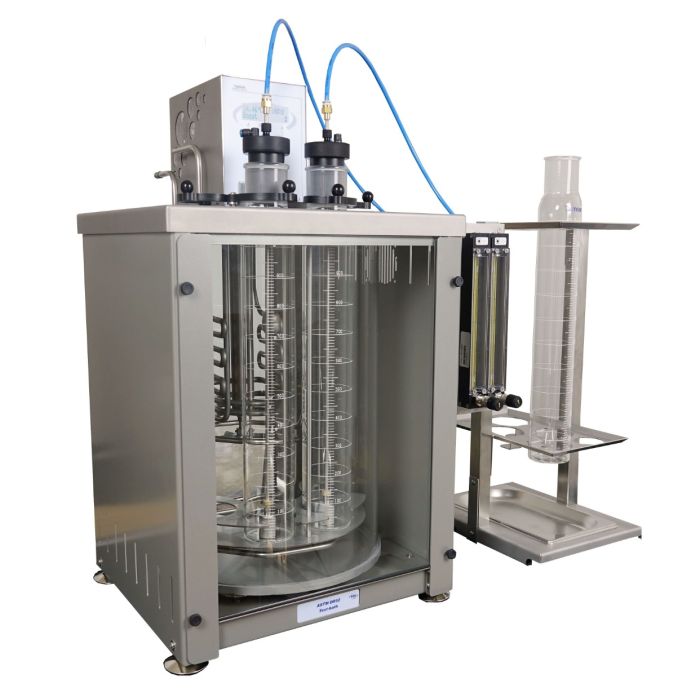
Standard Test Method for Foaming Tendencies of Non-Aqueous Engine Coolants in Glassware
These typically are 100% propylene glycol coolants, waterless engine coolants and high-boiling specialty coolants
The test determines both Foam volume immediately after aeration and Foam volume after a specified settling time. It covers a simple glassware test for evaluating the tendency of non-aqueous engine coolants to foam under laboratory controlled conditions of aeration and temperature.
Non-aqueous coolants have a higher viscosity, exhibit different surface tension behavior and use different additive systems.
Foam formation in cooling systems can lead to:
- Air entrapment
- Reduced heat transfer
- Pump cavitation
- Circulation inefficiency
A good coolant should produce minimal foam and allow foam to collapse rapidly.
The Tamson ASTM D892 Foaming Bath is available in the following voltages/frequencies:
- Tamson Foaming Single Bath 230V/50-60Hz (P/N: 00T0325)
- Tamson Foaming Single Bath 115V/60Hz (P/N: 00T0326)
See tab "More Information" for the specificationsheet and manual

Standard Test Method for Foaming Tendencies of Non-Aqueous Engine Coolants in Glassware
These typically are 100% propylene glycol coolants, waterless engine coolants and high-boiling specialty coolants
The test determines both Foam volume immediately after aeration and Foam volume after a specified settling time. It covers a simple glassware test for evaluating the tendency of non-aqueous engine coolants to foam under laboratory controlled conditions of aeration and temperature.
Non-aqueous coolants have a highre viscosity, exhibit different surface tension behavior and use different additive systems.
Foam formation in cooling systems can lead to:
- Air entrapment
- Reduced heat transfer
- Pump cavitation
- Circulation inefficiency
A good coolant should produce minimal foam and allow foam to collapse rapidly.
| Parameter | D1881 | D7840 | D892 |
| Fluid type | Coolant | Coolant | Oil |
| Base fluid | Water / glycol | Water / glycol | Hydrocarbon oil |
| Temperature regulation | ±1 °C | ±1 °C | ±0,5°C |
| Test temperature | 88 °C | 88 °C | 24°C; 43,5°C and 93,5°C |
| Air supply | 1000 ±25 mL/min | 1000 mL/min | 94 ± 5 mL/min |
| Sector | Heavy duty cooling | Automotive | Lubrication |
The Tamson ASTM D7840 Foaming Bath is available in the following voltages/frequencies:
- Tamson Foaming Dual Bath 230V/50-60Hz (P/N: 00T0345)
- Tamson Foaming Dual Bath 115V/60Hz (P/N: 00T0346)
See tab "More Information" for the specificationsheet and manual
| Bath_accuracy | 0.02°C |
|---|---|
| Bath Volume | 31L per bath |
| Bath height | 710 mm |
| Bath Width | 430 mm |
| Bath length | 380 mm |
| Bath max temp | +100°C |
| Minimum Temperature | +20°C |
| Specification | click here |
| Manual | click here |