


General
It measures:
- API gravity — a scale that expresses how heavy or light a liquid is compared to water
- Higher API = lighter oil
- Lower API = heavier oil
The method is used in crude oil testing, fuel and refinery products, quality control, pricing, and classification in oil & gas.
D287 is more API-focused, D1298 is more general-purpose:
- ASTM D287 → reports API gravity only
- ASTM D1298 → reports density, specific gravity, or API gravity
ASTM D287 is best for clear, low-viscosity liquids and less suitable for opaque, waxy, or very viscous samples.
Test
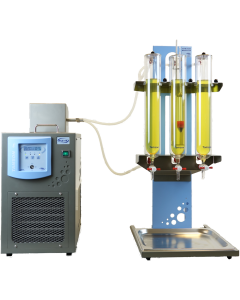
A glass API hydrometer floats in the sample. The depth of immersion depends on the liquid’s density, and the stem is graduated to read degrees API.
Sample is brought to a uniform temperature in the hydrometer cylinder. The TLC15 is used to keep the sample at constant temperature.
The result is corrected to a reference temperature (commonly 60 °F / 15.6 °C)
How D287 and ASTM D1298 compare
ASTM D287 → reports API gravity only
ASTM D1298 → reports density, specific gravity, or API gravity
D287 is more API-focused, D1298 is more general-purpose
ASTM D1298 vs ASTM D287
| Aspect | ASTM D1298 | ASTM D287 |
| Published by | ASTM International | ASTM International |
| What it measures | Density, specific gravity, or API gravity | API gravity only |
| Hydrometer type | Density / SG / API hydrometers | API hydrometer only |
| Typical outputs | kg/m³, g/mL, SG, °API | °API |
| Temperature correction | Yes (to 15 °C or 60 °F) | Yes (to 60 °F) |
| Use case | General petroleum testing & lab work | Crude oil & refinery API classification |
| Flexibility | More versatile | More specialized |