


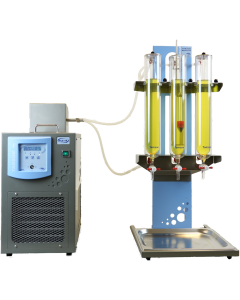
General
ASTM D1122 is a standard test method for determining the relative density (specific gravity) of engine coolant concentrates, aqueous engine coolants, glycols, glycerin, and other heat transfer fluids using a glass hydrometer. The test is primarily used in the automotive and industrial cooling industries for quality control and product verification.
The measured relative density can be used to estimate the glycol concentration of a coolant, provided the glycol type (such as ethylene glycol or propylene glycol) is known. From this information, the approximate freezing point and boiling point of the coolant can also be determined. For coolant concentrates, the test serves as an effective production control method to verify product consistency. Measurements are typically performed at 25 °C, 20 °C, or 15.6 °C, as specified in the applicable product specification.
Precision
ASTM D1122 includes precision statements based on interlaboratory studies.
- Repeatability (r): The difference between two test results obtained by the same operator using the same equipment should not exceed approximately 0.0012 relative density units for engine coolant concentrates with relative densities between 1.0000 and 1.1300.
- Reproducibility (R): The method also provides reproducibility limits for results obtained by different laboratories. These limits are larger than the repeatability values and depend on the relative density of the sample tested.
Test
ASTM D1122 determines the relative density (also known as specific gravity) of a coolant.
Relative density is the ratio of the density of a liquid at a specified temperature to the density of water at the same specified temperature.
Unit:
Dimensionless (no unit) , results are typically reported to four decimal places.