


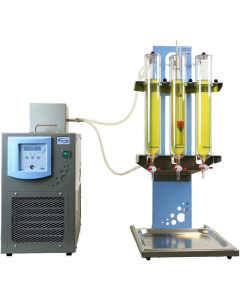
General
This is a test for determining the specific gravity (relative density) of water and brine free of separable oil. The standard provides four test procedures—pycnometer, balance, Erlenmeyer flask, and hydrometer—allowing users to select the most appropriate method based on the required accuracy and application. It is widely used in the oil and gas, chemical, salt production, and water treatment industries to determine brine concentration and verify product quality.
Precision
ASTM D1429 includes repeatability (r) and reproducibility (R) values based on interlaboratory studies for each test procedure. The pycnometer and balance methods provide the highest measurement accuracy, while the hydrometer method is preferred for rapid routine testing. Reliable results require proper temperature control and calibrated equipment.
Test
The method determines the specific gravity (relative density) of water or brine by comparing the density of the sample with that of water at a specified reference temperature.
The Reported result is the specific gravity (relative density) and unit used is Dimensionless (no unit)
Results are typically reported to four decimal places (e.g., 1.1254) together with the reference temperature, such as 15.6/15.6 °C (60/60 °F) or 20/20 °C.