


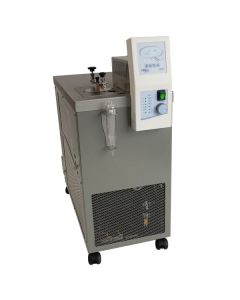
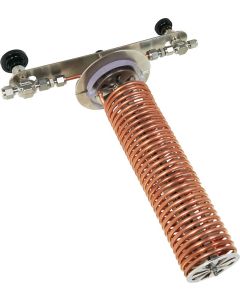
General:
Volatility, expressed in terms of the 95 % evaporated temperature of the product, is a measure of the amount of least volatile components present in the product. Coupled with a vapor pressure limit, it serves to ensure essentially single-component products in the cases of commercial grades of propane and butane. When the volatility is coupled with a vapor pressure limit which has been related to density, as in the case of the commercial PB-mixtures, the combination serves to assure essentially two component mixtures for such fuels. When coupled with a proper vapor pressure limit, this measurement serves to assure that special-duty propane products will be composed chiefly of propane and propylene, and that propane will be the major constituent. The presence of hydrocarbon compounds less volatile than those of which the LPG is primarily composed is indicated by an increase in the 95 % evaporated temperature. When the type and concentralion of higher boiling components is required, chromatographic analysis should be used.
Precision:
Repeatability: 6°C(1.0°F)
Reproducibility: 1.0 (1.7°F) for butane and butane-propane mixtures
3°C(2.3°F)forpropane
This test method has no bias because the volatility is defined only in terms of this test method.
Test:
The sample is refrigerated by means of a cooling coil and collect 100 mL of liquid in a weathering tube, The sample allowed to evaporate ( “weather") at ambient pressure under specified conditions. When 5 mL of liquid test portion remains, the observed temperature is corrected for barometric pressure and thermometer ice point error, and reported as 95 % evaporation temperature.
Differences between D1837 and D2158
|
Aspect |
D1837 |
D2158 |
|
Focus |
Evaporation Behavior |
Residue content |
|
Test type |
Functional |
Quantative |
|
Detects |
Poor volatility |
Nonvolatile contaminents |
|
Result |
Observation / behavior |
Mass of residue |
|
Purpose |
Performance |
Cleanliness |