


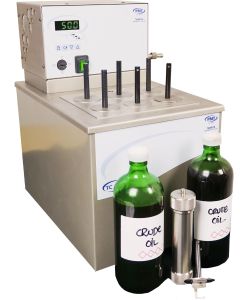
General:
This test method covers two procedures for the determination of the pour point temperatures of crude oils down to -36 °C.
- Procedure A provides a measure of the maximum (upper) pour point temperature.
- Procedure B provides a measure of the minimum (lower) pour point temperature.
Precision:
The method includes established repeatability and reproducibility values based on interlaboratory studies. Precision depends on the crude oil type and careful adherence to the prescribed sample preparation, thermal history, and cooling procedure.
Test:
The crude oil sample is first heated to remove its previous thermal history and then cooled under controlled conditions.
At 3 °C intervals, the test jar is tilted to determine whether the sample still flows. The lowest temperature at which movement is observed is recorded as the pour point.