


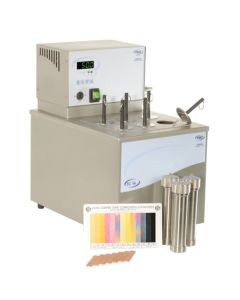
General:
A polished copper foil strip is immersed in a specific volume of the sample being tested and heated under conditions of temperature and time that are specific to the class of material being tested. At the end of the heating period, the copper foil strip is removed, washed, and the color and tarnish level assessed against the ASTM Copper Strip Corrosion Standard
There are a variety of test conditions of time or temperature.
In general, aviation gasoline shall be tested in a pressure vessel at 100 °C (212 °F) and other high vapor pressure fuels, like natural gasoline or winter-grade gasoline at 40 °C (104 °F).
Other liquid products shall be tested in a test tube at 50 °C (122 °F), 100 °C (212 °F) or even higher temperatures.
The temperature conditions (but not the time durations) given are commonly used and are quoted in the ASTM specifications for these products tested.
Precision:
The method includes established repeatability and reproducibility values based on interlaboratory studies. The precision depends on proper instrument calibration, temperature control, and adherence to the specified operating procedure.
Test:
Interpretation of the corrosiveness of the sample is in accordance with one of the classifications of the ASTM Copper Strip Corrosion Standard.