


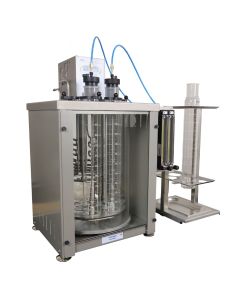
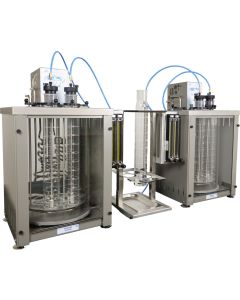
General
The tendency of oils to foam can be a serious problem in systems such as high-speed gearing, high-volume pumping, and splash lubrication. Inadequate lubrication, cavitation, and overflow loss of lubricant may lead to mechanical failure. This test method is valuable in the selection of oils suitable for such operating conditions.
On the other hand, Mott metal diffusers have a 100 % acceptance rate. Hence, it is preferable to use the metal diffusers, even though they cost more than the stones.
The gas diffuser can be either a 25.4 mm (1 in.) diameter spherical gas diffuser stone made of fused crystalline alumina grain, or a cylindrical metal diffuser made of sintered five micron porous stainless steel.
Precision
Seq. I Tendency: Repeatability = 0.7076X0.7909
Seq. II Tendency: Repeatability = 0.2119(X + 27.1933)
D892, Seq. III Tendency: Repeatability = 1.3640X0.6872
Test
The sample maintained at a temperature of 24°C(75°F) is blown with air at a constant rate, then allowed to settle for 10 min. The volume of foam is measured at the end of both periods.
It is critical that the diffusers be first tested for maximum pore diameters and permability as given in the mandatory annex to the test method. A schedule for cleaning and replacing the diffusers should be established. A 1994 ASTM crosscheck showed serious disagreement in testing the diffuser porosity.