


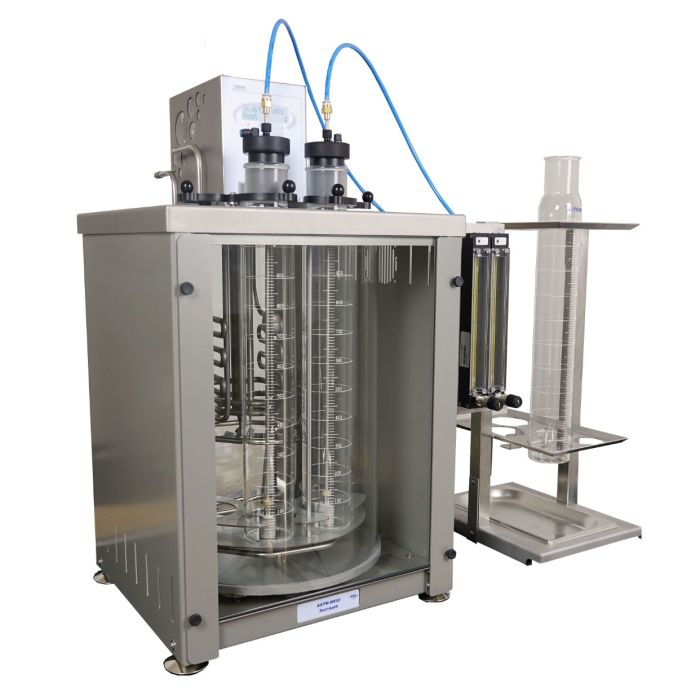
STM D1881 measures the foaming tendency and foam stability of engine coolants, antifreeze concentrates and engine coolant mixtures.
It determines both Foam volume immediately after aeration and Foam volume after a specified settling time.
A good coolant should produce minimal foam and allow foam to collapse quickly.
Foam volume (mL) at end of aeration and Foam volume (mL) after settling time is reported Uses glassware apparatus
The setup includes a controlled airflow system with a filter set for the used air. Both the diffusers (Stone or MOTT type) and the flow tubes are calibrated and provided with a work certificate. The measured values are traceable to the national standard.
The Tamson ASTM D1881 Foaming Bath is available in the following voltages/frequencies:
- Tamson Foaming Single Bath 230V/50-60Hz (P/N: 00T0345)
- Tamson Foaming Single Bath 115V/60Hz (P/N: 00T0346)
See tab "More Information" for the specificationsheet and manual

Standard Test Method for Foaming Tendencies of Engine Coolants in Glassware
This test method covers a simple glassware test for evaluating the tendency of engine coolants to foam under laboratory-controlled conditions of aeration and temperature.
ASTM D1881 measures the foaming tendency and foam stability of:
- Engine coolants
- Antifreeze concentrates
- Engine coolant mixtures
And determines both Foam volume immediately after aeration and Foam volume after a specified settling time.
Foaming in cooling systems can cause:
- Air pockets
- Reduced heat transfer
- Cavitation
- Pump inefficiency
- Engine overheating
A good coolant should produce minimal foam and allow foam to collapse quickly.
A measured volume of coolant is placed in a graduated glass cylinder and this sample is maintained at a specified temperature. Air than is introduced at a controlled flow rate for a defined time. Than the foam height is both measured immediately after aeration and after a settling period (usually seconds).
Foam volume (mL) at end of aeration and Foam volume (mL) after settling time is reported Uses glassware apparatus
The setup includes a controlled airflow system with a filter set for the used air. Both the diffusers (Stone or MOTT type) and the flow tubes are calibrated and provided with a work certificate. The measured values are traceable to the national standard.
The difference between ASTM D1881, D8740 and D892
| Parameter | D1881 | D7840 | D892 |
| Fluid type | Coolant | Coolant | Oil |
| Base fluid | Water / glycol | Water / glycol | Hydrocarbon oil |
| Temperature regulation | ±1 °C | ±1 °C | ±0,5°C |
| Test temperature | 88 °C | 88 °C | 24°C; 43,5°C and 93,5°C |
| Air supply | 1000 ±25 mL/min | 1000 mL/min | 94 ± 5 mL/min |
| Sector | Automotive | Heavy duty cooling | Lubrication |
- Tamson Foaming Dual Bath 230V/50-60Hz (P/N: 00T0330)
- Tamson Foaming Dual Bath 115V/60Hz (P/N: 00T0331)
See tab "More Information" for the specificationsheet and manual
| Bath_accuracy | 0.02°C |
|---|---|
| Bath Volume | 31L per bath |
| Bath height | 710 mm |
| Bath Width | 430 mm |
| Bath length | 380 mm |
| Bath max temp | +100°C |
| Minimum Temperature | +20°C |
| Specification | click here |
| Manual | click here |